Formula recalculation passes; source integrity does not yet pass the release gate.
The frozen snapshot draws a high-citation cohort from education-type OpenAlex entities. It measures research bibliometric proxies—not teaching, employment, student experience, reputation or overall university quality. The V2.0 comprehensive ranking remains a research preview.
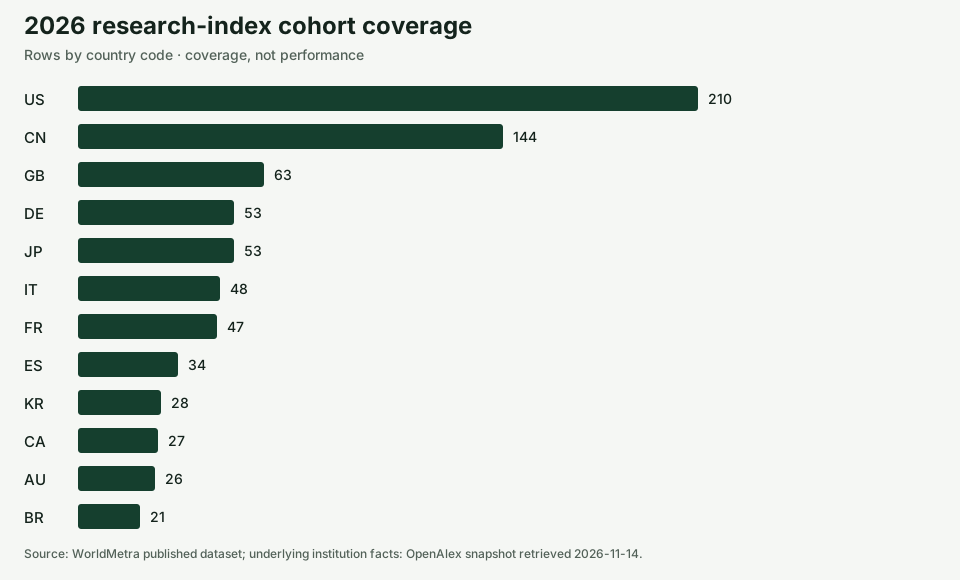
Coverage statistics describe dataset structure, not national education quality.
The cohort contains 210 US-coded rows, 144 China-coded rows, 63 UK-coded rows, and 53 each for Japan and Germany. Within the top 100, the US accounts for 47 rows, the UK 10 and China 8. This concentration is affected by aggregate-citation selection, institutional scale, subject mix, accumulated history and OpenAlex coverage; it does not establish national causal advantage.
The formula, components, total scores and positions pass deterministic recalculation.
The verification script reads the frozen JSON and method v1.0, applies log1p transforms to citations, works, H-index and two-year mean citedness, computes within-cohort percentiles and applies 45/25/20/10 weights. Across 1,000 rows there are 0 component or score mismatches above 0.011, 0 rank mismatches and 0 duplicate OpenAlex IDs.
Every entity has activeYears=5 and a continuity score of 100. The 10% continuity weight therefore changes no rank, while lifting and compressing all scores. It must be removed, redefined or replaced before the next edition.
These findings concern the cohort and method—not “the world’s best universities.”
- Within the cohort, median works are 73,388.5, median citations 4,924,303.5 and median H-index 575.5.
- Median two-year mean citedness is 5.743; it is 25% of the quality proxy, or 6.25% of the total score.
- Aggregate citations and works are absolute scale measures and are not normalized by field, FTE or author contribution.
The full-cohort comparison exposes systematic source differences with an unresolved root cause.
The audit matched 1000/1,000 OpenAlex IDs. With a material-difference threshold outside a 0.8–1.2 current/frozen ratio, differences affect 0 works counts, 999 citation counts, 754 H-indices and 471 two-year mean-citedness values. The median citation ratio is 0.40245, so the current value is about 40.2% of the frozen value. This scale cannot be treated as ordinary six-day drift; original responses, request parameters and transformations still need recovery.
Current OpenAlex metadata marks 27 rows inactive and 7 as super-systems; 50 rows have another published cohort entity in current lineage. Automated screening is triage only: 82 rows enter high manual review, 5 enter duplicate/relationship review and 913 still need degree-awarding evidence. Final manual eligibility decisions are 0/1,000.
OpenAlex type=education, a ROR ID or current lineage cannot alone determine inclusion or exclusion. The edition remains frozen; a corrected version requires source recovery, row-level eligibility decisions, impact calculation and a published correction notice.
Download the 1,000-row audit CSV → · Official OpenAlex institution documentation →
Reviewers can download the frozen version, full audit and checksums.
Dataset, CSV, JSON, full audit and SHA-256 →
Method v1.0, formula and limitations →
Suggested citation: WorldMetra (2026), Global University Research Index: source integrity and reproducibility report, 20 November 2026; frozen historical edition, source-integrity review open; add your access date.